Can We Really Just "Keep Calm and Carry On"? (STS NL 2026)
When the noise of the world gets too loud, can researchers really just "keep calm and carry on"? Thoughts from STS-NL on academic responsibility, personal reflection on my uncomfortable preference sitting on the quiet office chair, and finding my path as an early-stage PhD.

I feel really bad that I'm writing this so late, even more than a month passed after STS-NL conference. This is partly because I was caught up in my own work (which ironically relates to the experience I'm going to write about), but also because I usually like to let my thoughts brew over time rather than responding immediately. Both approaches have pros and cons, but I'll try to share my thoughts more quickly now that I have this new personal venue for writing.
At STS-NL, a very familiar type of incident happened, but it ended in an unusual way.
There was a technical issue during the WTMC 40th anniversary plenary, an electrical noise suddenly burst and filled the whole lecture hall. So far, so usual... We experience these things quite often, and I bet everyone expected it to be resolved quickly.
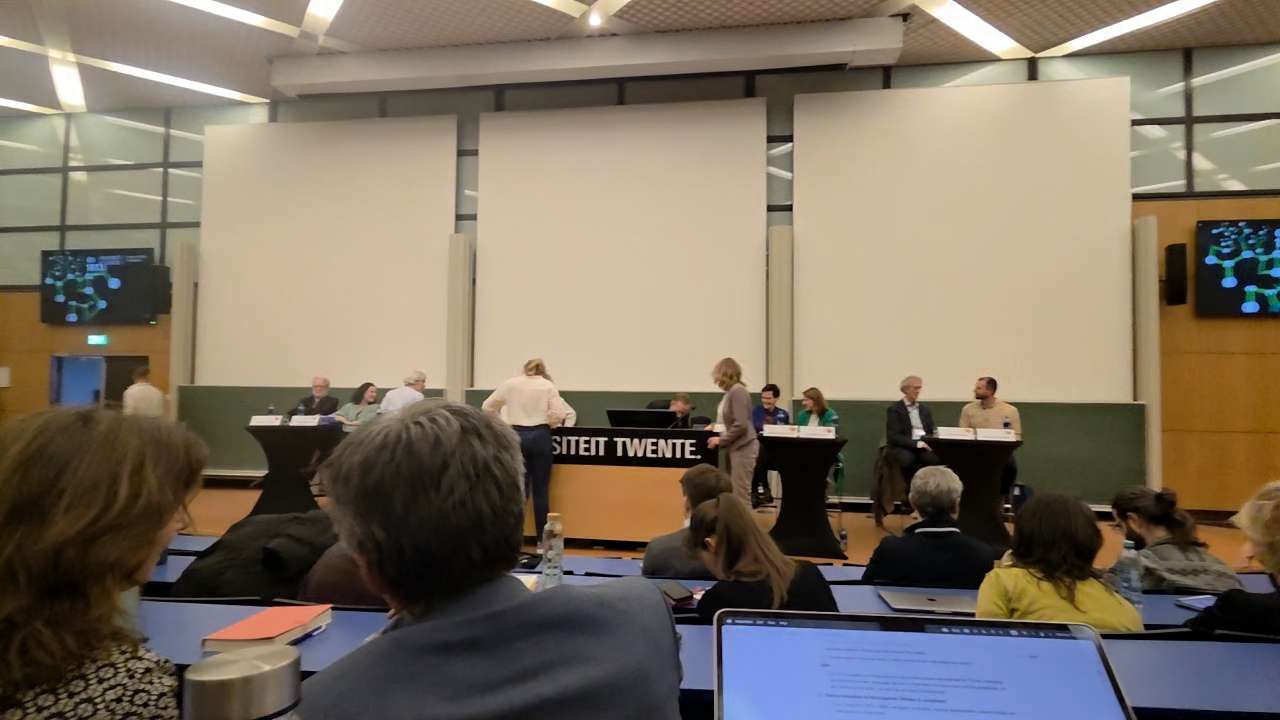
But the thing was, it didn't. It felt like it went on for dozens of minutes (though it might be probably shorter in reality). Assistants tried to fix it, but eventually, they all failed, and Sally Wyatt, acting as chair, had to wrap the session up early. It was barely possible to hear her voice over the noise, but we understood what we had to do through her gestures.
Because the plenary took place in a separate building to accommodate the large audience, we had to exit and walk back to the main venue. The doors even required an officer to scan a card for every person leaving, so it took quite a while to finally escape the sound.
For me, this felt like a metaphor for the current status of STS, or even academia at large.
Earlier in that same session, before the noise started, there was a Q&A between the audience and the panel. One of early career researchers asking Wiebe Bijker what we should do as STSers in these troubled times, with extremists distracting and misleading the public as the world gets worse. I honestly cannot remember fully the whole question or the exact context, but it reminded me of ongoing wars, the climate crisis, or even the AI hype-driven tech-oligarchy.
Surprisingly, Wiebe Bijker answered by quoting the famous UK slogan, "Keep Calm and Carry On." This left people feeling somewhat unsatisfied, and I guess it even grated on some nerves. Later, he mentioned he might have picked the wrong phrase and clarified that he meant we shouldn't get dragged down by the rhetoric, but rather focus on what we can do and what we do best: rigorous and robust research.

I don't want to refute his answer, and I do somewhat agree with him. To be honest, I am a person who feels more comfortable being a researcher who sits in an office chair, observes things, writes down my thoughts, and derives scholarly ideas from them.
But as someone who always feels a sense of indebtedness to activists, his answer was not resonating this time. Maybe I wanted—even if they were just words—some encouragement to act against it, to raise our voices, and to find more ways for direct political responses, not just as citizens, but as researchers allying with the citizens.
It was not directly after that conversation (and if it was, it would have felt like a divine(?) sign to us all..!), but not long after, the sound incident happened.
The metaphor that struck me was this: there is definitively a sound, an event, or an environment that makes all of us stop doing our work.
When we can no longer do what we are used to doing under certain circumstances, we have to hastily disperse. And I ask: what if now is that time? What if everything we see and feel—which genuinely looks like a crisis—is the noise that happened in that hall? What if this is a case where we cannot just "keep calm and carry on"? Then what should we do? What are our responsibilities as STSers, researchers, and academics?
Coincidentally, though, there was a WTMC workshop a month later, and the reading list included an old article asking what STS is for, and how it is forgetting its connection to activists' critical thoughts and practices (Martin, 1993). I enjoyed reading it while recalling this anecdote.
This struck me so hard that I actually consider this experience more important than my first presentation as a PhD at the conference. I was indeed thinking about what kind of research I wanna do, and who I wanna be as a researcher when I decided to shift my career from industry back to academia. Of course, I don't have an answer right now, and I won't try to force one here. I even think I can think of an answer in near future. Paradoxically I'll just carry on with this afterthought myself, but I'm not sure if I could keep calm enough when doing so.
Reference
Martin, B. (1993). The Critique of Science Becomes Academic. Science, Technology, & Human Values, 18(2), 247–259. https://doi.org/10.1177/016224399301800208